Maybe fifteen years ago, at a Southern California flea market, I found a yellow Kodak box of color slides with “Raymound”—yes, with a U—written across it.
I pulled out the first slide and held it toward the California sun.
Bettie Page.
And a photograph of Bettie I’d never seen before.
Sold.
When I got home, I went through the rest and discovered another Bettie among a couple dozen wonderfully tame, slightly mysterious “girlie” photographs. Then I did what collectors do: I put the box away.
For about a decade.
Recently, I rediscovered Raymound’s slides, scanned them, and decided it might make a terrific little Thing. So I started laying my idea out.
Once I had a proof, I sent it to my friend Eric Kroll. Eric knows more about the history of erotic photography than just about anyone, and he sent back a terrific piece of writing.
Problem was, the book was already designed.
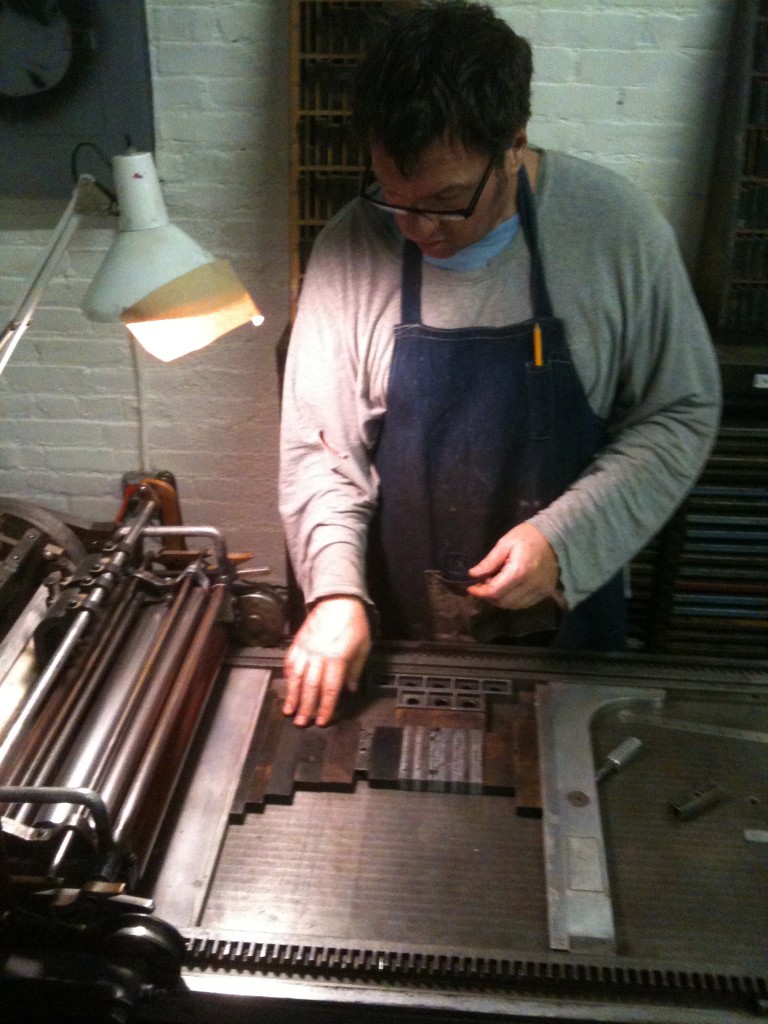
So Eric’s contribution became an addendum. I letterpress-printed 100 copies, then drove down to Tucson, where Eric and I had lunch and he signed (and I numbered) every one.
Eric had titled his piece Early Girlie!
So, sure. Kroll landed the title.
The “Restricted to Adults” belly band came next, inspired partly by the famous WARNING band on the first edition of Henry Miller’s Tropic of Cancer and partly by those wonderfully ominous warnings early publishers of adult material used in an effort to keep themselves out of trouble.
The funny thing is that these photographs are incredibly tame by today’s standards. That’s part of their charm.
Finally, I needed something sturdy to house the finished book. I found heavy cardboard mailers originally intended for shipping a single DVD. Early Girlie! fit perfectly.
But I couldn’t leave them blank.
So I went back to the era of the slides—to Titter, Wink, Beauty Parade and the other men’s magazines where photographs like these were advertised. I found an original mail-order advertisement for “Color Slides – Studies in Beauty,” scanned it, turned it into a PDF, and had a rubber stamp made from it.
Then I hand-stamped all 100 envelopes.
A forgotten yellow Kodak box marked “Raymound,” and destined for the trash before a picker got it; one unexpected glimpse of Bettie Page in the Southern California sun, ten years on a shelf, twenty-four photographs, a road trip to Tucson, a Vandercook SP-15, Eric Kroll, Henry Miller, an old men’s magazine advertisement and 100 rubber-stamped envelopes later…
Edition of 100 numbered copies. Square format (4.75 × 4.75 inches / 12.1 × 12.1 cm). Ten pages reproducing twenty-four anonymous vintage “girlie” color slides discovered in an original mail-order slide collection. Cover reproduces a Bettie Page photograph from the series.
Issued in a custom heavy kraft envelope printed with a reproduction of a mail-order advertisement for the “Color Slides – Studies in Beauty” series from which the photographs possibly originated. Each copy includes a letterpress-printed addendum by Eric Kroll, hand numbered and signed by the author. The addendum was printed by Jim Camp from a polymer plate on a Vandercook SP-15 press and is laid into each copy beneath a printed belly band reading “Restricted to Adults.”
Designed, printed, and published by Jim Camp at the synaesthesia press.
Notes: The photographs reproduced in the edition are anonymous and date from approximately the mid-1950s. The project originated after finding the original box of slides at a flea market. The edition was conceived by Camp as both a contemporary artist’s book and an homage to mid-century mail-order photography.
The Musical Instrument Museum sits on a stretch of North Phoenix that, in my mind at least, will always be desert. Fifty years ago I was riding dirt bikes out there. Literally. In MIM’s exact spot. Now that desert is home to one of the most remarkable museums I’ve ever visited. Leave it to an old dude to get sentimental about a patch of dirt mixed with dry washes, Saguaros, and Palo Verde trees. If you’re visiting Phoenix, MIM is worth at least half a day. If you’re an instrument junkie, it borders on being a destination all by itself. I had no idea so many instruments existed, let alone that someone had managed to gather them under one roof. You can wander from Swedish nyckelharpas to giant Belgian orchestrions to Roy Orbison’s Gibson ES-335 “Dot” he played during his stint as a Wilbury. Pictured here is an instrument I picked up in middle school, mastered by college, and have abandoned since: the Air Guitar. Its placard identifies as being made of “Nitrogen, Oxygen, Argon, Carbon Dioxide, and dreams.” Which is exactly why I played it: “Whole Lotta Love,” “Free Bird,” and just about everything on Van Halen’s first record were my early influences. Oh! Surprise bonus—the Chicken Posole soup. I came for the instruments, got sidetracked by an Air Guitar and left thinking about lunch. All in all, a pretty great day.
Right now I’m finishing up a bibliography of the synaesthesia press. “Checklist”? Feels like a better word? “Bibliography”? Maybe a little too formal, a little too academic? I dunno. What I’m really trying to do is document what I’ve published over the last thirty years before I forget everything. I’ve been surprised by my reaction to the project. Part of me is genuinely proud. Proud of the books. Proud of the authors. Proud of the broadsides, chapbooks, oddball Voltas, and all the strange little things I’ve published. Looking back, I can see threads running through the whole thing: Bukowski, Brautigan, Wallace Berman, Billy Childish, small presses, found photographs, letterpress printing. The other part of me wonders: is the whole exercise self-congratulatory? And if any of this really mattered, wouldn’t somebody else be writing it down? Probably not. The truth is that every publication has a story attached to it, and stories disappear faster than books. So for now, I’m trying to save the stories while I still remember them all. Now if I could just find find my copy of Harold Norse’s Sniffing Keyholes.
I watched Narvik and thought it was terrific. Not terrific “for a foreign film.” Or because it’s a foreign film. It’s terrific, period. Before watching it, I knew almost nothing about the Battle of Narvik. Somehow this chapter slipped through my WWII cracks. Which got me thinking: why do many middle-aged and older men—particularly white dudes—pop a boner over World War II? Patton Oswalt said something funny about that, but I forget it now. But that’s not what stayed with me about Narvik. Beneath the battle scenes and military history is a brutal moral question: would you save your own child if doing so meant betraying an Allied position to the Nazis? Not a spoiler alert, BTW. If you have Netflix, check it out.
One of the (many) books on my nightstand right now is Elizabeth Winder’s Marilyn in Manhattan: Her Year of Joy. Like everyone, when I think about Marilyn, I think of sadness, addiction, loneliness, and the way her story ultimately ends. The idea that there was a year in which she was genuinely happy was enough to make me pull the book from the shelf. Here’s a Marilyn who is finally beginning to discover her own strength, independence, and sense of self. A woman trying to stand on her own two feet. Of course, she had to find her way to Manhattan to do that. Where else does a person go to reinvent themselves? (OK, shout out to San Francisco). My favorite scene so far comes before Marilyn even leaves Hollywood. Her roommate, Shelley Winters, invites a Welsh poet named Dylan Thomas over for dinner. Thomas proceeds to drink everything in sight before deciding he needs to get to Charlie Chaplin’s place in Calabasas, where The Party is underway. So Dylan goes. And Shelley goes. But Marilyn taps out. There’s your one-act play.
THING 5. Early Girlie!
In addition to Scot Sothern’s Sweet Adeline, I’ve been working on Early Girlie! and, if all goes according to plan, it will be available in July in an edition of 100 copies. The project grew out of a small box of anonymous color slides from the 1950’s I found years ago on one of my many flea market adventures. Most are “cheesecake” pictures—ordinary women posing in an era when even mildly risqué pictures could get you into some serious legal trouble. For example, all the pictures in Early Girlie! are pube-free. What always interests me isn’t the photographs—but the people and circumstances behind them. These were clearly commercial images, probably produced by a single photographer working with professional models. My guess is he started out in a camera club and either found a producer willing to back the work, or he (she?!) had enough money of their own to pay the models and recover the investment by retailing the finished sets. Bettie Page’s name is one of the few that survived the era. Most didn’t. I’ve always been fascinated by the small details that history leaves behind. Give me a name and I can spend an afternoon chasing it. There’s almost always a terrific story behind an unknown name. Unfortunately, in many cases the photographs survived while the names of the women who posed for them and the photogs who made them did not. Early Girlie! is a small square format featuring selections from the slides along with what I’m calling an “addendum” written by Eric Kroll laid-in to the book. Like many of the projects I enjoy most, it sits somewhere between photography, found imagery, vernacular history, collecting, and bookmaking. It’s also a reminder that sometimes the best publishing projects begin at a flea market and not with a manuscript.