Posted on Leave a comment

Volta 2 | synaesthesia press

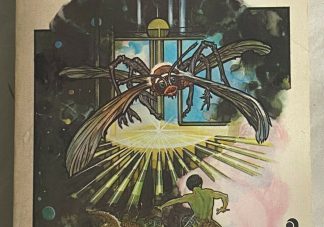
Volta 2, a 2009 synaesthesia press mixed-media portfolio containing poetry, fiction, photography, found imagery, artwork, and printed ephemera housed in an illustrated envelope.

Published 2009 by the synaesthesia press.

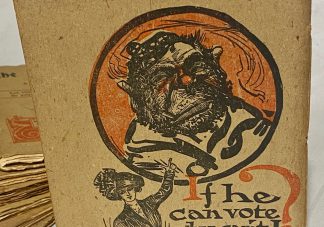
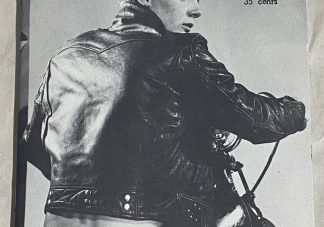
Portfolio. Approximately 6″ × 9″ (15.2 × 22.9 cm). Housed in a black envelope illustrated with a vintage men’s magazine advertisement printed using Print Gocco. Edited, designed, printed, and assembled by Jim Camp and Nathan Feller. Published by the synaesthesia press.

Edition of 100 copies printed at the synaesthesia press in Tempe, Arizona and Los Angeles, California.

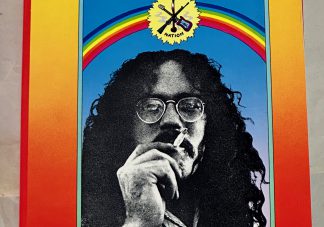
In addition to the printed colophon, the contents include the artwork “Welcome! Well, Hello!” by Nathan Feller; the short story “Natural Sines & Cosigns, Tangents & Cotangents (A Love Story)” by Jim Pritchard; the photograph “Herbert Huncke Smoking a Sherm in the Back of a NYC Cab” by Laki Vaz; a found photograph digitally altered by Jim Camp; a found, color transparency selected by Jim Camp; and poems by Henry Tokarski (“Black Spring”), Marie Kazalia (“No Elvis Sightings”), Charles Bukowski (“Untitled”), Richard Brautigan (Widow’s Lament”), and Henry Denander (“Workth”). Most letterpress printed.

The second issue of Volta marked a transitional moment in the history of the press, produced in the middle of its move from its second Arizona period to its Los Angeles period. Conceived as a mixed-media portfolio rather than a traditional literary magazine, the publication brought together contemporary writing, found imagery, photography, visual art, and ephemera in a format heavily indebted to Wallace Berman’s Semina, as well as mail art, and other experimental assemblage publications.

Unlike the later issues of Volta, the first two function as an open container for disparate voices and forms, emphasizing juxtaposition, surprise, and the relationship between text and image.

“Art is Love is God.”

Availability: Out of print.

Posted on Leave a comment

Henry Tokarski | To Sherri O’Brien From Morrell Park in Northeast Philadelphia

The synaesthesia press used to maintain a few listings in directories soliciting poetry manuscripts for chapbook consideration. I’m not particularly fond of the practice, but who knows? The next Charles Bukowski might be sitting in a cheap room somewhere, pounding out poems and looking for a place to send them.

Like every small-press publisher, I receive far more work than I could ever print. Most of it simply isn’t for me.

Then Henry’s manuscript arrived.

From the first poem I read, I was hooked. In fact, I decided to publish the book before I reached the end of the submission.

Whenever people asked me what Henry’s work was like, I found myself giving the same answer: Brautiganesque.

I know. I hate to pigeonhole, and labels are imperfect. But we apply them to everything—books, music, people—whether they fit or not. Still, it was the closest comparison I could make. Henry’s poems possessed that same clarity, gentleness, humor, and emotional precision that made Richard Brautigan’s best work so memorable.

As the project began taking shape, I asked Gerald Locklin to contribute an introduction. His assessment was better than anything I could have written myself:

“Henry Tokarski has produced a sequence of youthful, credible love poems in a time not hospitable to such efforts…”

Locklin went on to praise the poems’ restraint, emotional intelligence, and ability to leave space for the reader. I remember reading his introduction and feeling reassured that my instincts had been correct.

The book was designed. The type was set. A publication date was announced.

And then life happened. At the time I was working full-time, and despite every intention of publishing the book, I never found the time to complete it.

Years passed.

After I retired, one of the projects I most wanted to revisit was Henry’s book. I tracked down his contact information, eager to finally finish what I had started. That’s when I learned Henry had died. The news hit me harder than I expected.

Publishers accumulate unfinished projects over the years. Most quietly fade away. This one never did. Henry’s manuscript remained on my shelf, patiently waiting.

It still is.

One of the great regrets of my publishing life is that To Sherri O’Brien From Morrell Park in Northeast Philadelphia never appeared when it should have. One of my hopes is that it still might.

Some books arrive on schedule.

Others take the long way home.