Posted on 1 Comment

Five Things, Right Now: Ace, Richard Prince, Stephen Shore, & a couple more.

Thing 1: RIP Ace.

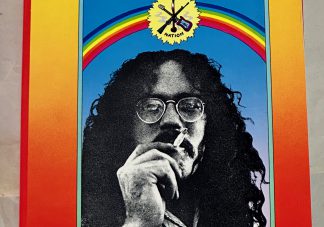
My earliest record-buying memory goes back to the fall of 1975 and a Phoenix grocery store chain called “Smitty’s Big Town”. Long before Costco, Smitty’s figured out that people might want to buy their groceries, a tennis racket, a toaster, and a bike all in one place; hence, it’s a Big Town. For Sixth Grade Me, that meant one very important thing: Big Town’s small — but magical — record section tucked between the last of the food aisles and the sporting goods. I first saw KISS Alive! rifling through their tiny ROCK section, but I already heard about the record. And certainly the band. The rumors were already circulating at my middle-school (and probably yours, too): were they Satanists? Knights in Service of Satan! Did they even actually play their instruments? And certainly Gene Simmons had a cow’s tongue sewn onto his own. I asked my mom for the album, but she scoffed — maybe because double albums cost more, maybe because she just didn’t want that noise in her house. Her official reply: “You don’t like acid rock, so go put it back and meet me up at the cashier’s.” I said: “OK.”

(Photo credit: Chalkie Davis).

Thing 2: Richard Prince  Early Photography 1977–1987.

I caught Prince’s Gagosian show built around this book last spring in New York. What I love about Prince—pictures or paintings—is how approachable the work feels, which, I know, sounds ridiculous when you consider that thing called appropriation. But that’s the point for me, same as with Warhol and Duchamp: it’s less about how “easy” the work seems (I can do that!) and more about the reaction it provokes. I love watching people grow furious. That energy becomes part of the piece. And being at the gallery and standing in front of these prints really tightened it all up—Prince’s deadpan humor, the re-framing, the way an image shifts when you simply say it’s art. Because it is art, and no…you couldn’t do it.

Thing 3: Scot Southern.

I’m pretty sure I met Scot Sothern’s Work and Scot Sothern The Man at the same time—at his These Days show a handful of years ago—and I’ve been a fan ever since. I love his writing as much as his photography as much as his art. His voice, the imagery, our shared idea of the human condition— it hits me the same way a terrific Bukowski poem or one of Vollmann’s Tenderloin stories or some of Mikailov’s toughest photographs. In fact, I like Scot’s work so much the synaesthesia press will be publishing one of Scot’s short stories in the not-too-distant future.

Thing 4: Sofiya Loriashvili куряче крило.

куряче крило means “chicken wing”, and the fine folks at Paper Work just published Sofiya Loriashvili’s book in an edition of 100. I didn’t know her work; I did know Boris Mikhailov’s Case History—and the second I saw Paper Work’s advert for Chicken Wing I flashed back to the remaindered art book store near the Pompidou in Paris well over a decade ago. (It’s since closed.) It’s where I pulled a copy of Case History for 10Euros, and it’s been rattling around in my head ever since. Loriashvili isn’t doing Mikhailov, exactly, but his influence is there: the toughness and tenderness of looking straight at a place and its people without flinching, and then letting a small, ordinary moment do the heavy work. Which is a fancy way of saying the photog is limiting their audience. Which is a fancy way of saying Chicken Wing ain’t for everyone—bleeding heads and shootin’ dope and panties bled through—or, in other words, young Ukrainians barely holding their own in their (our) fucked-up world. I’m in for two copies.

Thing 5: Stephen Shore — Early Work.

If I could trade creative lives with anyone, I think it’d be Stephen Shore. I’ll digress: as a kid I watched my mom work her Canon AE-1; as an adult I found my grandpa’s color slides from the late ’40s/early ’50s. So yeah, I’ve always wanted to be a photographer—maybe it was even in my DNA? But I never wanted to be “that guy.” You know. The one with the camera flung around his neck asking people to hold still. Call it imposter syndrome, call it low artistic self-esteem. Call it not wanting to be perceived as creepy. I picked up a camera now and then during the 90’s (mostly then), but I never pushed it. Shore did what I couldn’t; and then, as a young man in the mid-60’s, he walked straight into the peak of Warhol’s Factory. With a camera flung around his neck being that guy. I’d almost sell my soul for that. (Maybe not.) What I love about Early Work is how assured his young eye already is—the quiet strangeness of ordinary life most people miss. It coincides nicely with Prince’s Early Photography: two photogs figuring out what pictures can do—one by re-defining images that already exist, the other by noticing the world most of us miss.

Posted on Leave a comment

Five Things, Right Now.

Thing 1: Pig by Sam Sax

On a not-so-recent run to Tucson—my favorite Arizona city—I ducked into another favorite, Antigone. There on the shelf, face out for maximum marketing, was Pig by Sam Sax. Gotta love when they face-out a book of poems! And yeah, I know: only suckers judge books by their covers. But whoever designed Sax’s cover deserves a gold medal pinned to their chest. It made me grab it. Heads up: these poems aren’t for everyone. Take Pig Bttm Looking for Now—raw, unflinching, and exactly the kind of poem that makes me lean in instead of looking away. I grabbed Pig for its cover, but Sax’s poems made me buy it.

Thing 2: Erik Satie

While scouring my usual places for interesting pictures to post on Instagram, I stumbled on a Man Ray portrait. The subject? Someone I didn’t know: Erik Satie. Turns out he was a French composer—and a full-on oddball in the best way, which is right up my alley. Satie wandered Paris in velvet suits, carried a small hammer just in case (no one ever pinned down what, exactly, “just in case” meant), and kept seven identical grey suits so he could always look like a “priest of boredom.” He collected umbrellas, ate only white foods (eggs, sugar, grated bones, animal fat, veal, salt, coconuts, rice, turnips, pastry dough, and certain cheeses), and scribbled musical directions like to be played like a nightingale with a toothache. And yup, Satie’s streaming everywhere. Even Bandcamp. Right now. On my player.

Thing 3: Flagstaff, Arizona

I’ve talked about Flagstaff before. It sits at 7,000 feet in northern Arizona, tucked into ponderosa pine forests at the base of the San Francisco Peaks. Once a railroad and lumber town, today it’s a mix of college energy, mountain-town super funk, and gateway-to-the-parks tourism. With four seasons—snow in winter, wildflowers in summer—it feels like a different world from the desert where I dwell just two hours south. Back in March I spent 48 hours here. Well—I’m back again now, winding down my week-long road trip. Not many bookshops to duck into; I drink my coffee at Macy’s; and I take my doggo Molly for a walk in Wheeler Park. I could never spend the rest of my life here, and certainly no more than a few days during the winter. But the summer? Just point me toward a cabin within walking distance of my coffee spot and Molly’s park, and I’ll sign the 6-month lease.

Thing 4: Gay Nazis

Go ahead and think I’m crazy, but yeah—a friend and I brought up Gay Nazis in a conversation today. Specifically, the Brownshirts (SA), Hitler’s original street thugs in the ’20s and ’30s. They wore brown uniforms, roughed up opponents, and helped pave Hitler’s rise to power. Their leader, Ernst Röhm, was openly gay—unusual in Nazi ranks. Plenty of the SA followed suit. For a while Hitler and Röhm were very close. Röhm was useful. And when he wasn’t, you probably know the end of that story. So when a reporter asked The President how he was holding up after Charlie Kirk’s death—and the flippant answer “I think very good” before pivoting to brag about a new White House ballroom? No, the President didn’t have Charlie killed. But of course that’s an absurd response concerning someone who most likely got him to the place he is right now. Which somehow feels like it came straight out of history’s darker chapters. Just like a lot of other things happening right now. So yeah. Gay Nazis.

Thing 5: Pro Wrestling as Modern Folk Theater

The night before I left on this road trip, I shot the 7th anniversary show for Phoenix Championship Wrestling. Sure, we all know people love to mock wrestling as fake and stupid and just guys in tights pretending. But what they miss is the higher thing: pro wrestling as modern folk theater. Oh sure, you’re laughing. But hear me out—it’s a morality play in spandex, storytelling to scream back at (or laugh at), complete with heroes, villains, betrayal, and redemption—all unfolding in a ring that doubles as a stage. Like commedia dell’arte or old morality plays, the characters are archetypes: the cheating heel, the babyface who won’t quit, the crowd deciding in real time who deserves the win. It’s not about suspension of disbelief—it’s about collective belief. And there’s nothing like watching it in person. Of course everyone knows it’s scripted, but for a couple of hours, why not agree to play along? In that shared performance, wrestling feels as old as theater itself.

Leave it to a wrestling-nerd-cum-intellectual-book-nerd to critically think about wrasslin’.

Posted on Leave a comment

Five Things, Right Now.

I’ll kick off this installment with this quote from The Monkey Wrench Gang: “Seldom Seen Smith was in the river-running business. The back-country business. He was a professional guide, wilderness outfitter, boatman and packer. His capital equipment consisted basically of such items as rubber boats, kayaks, life jackets, mountain tents, outboard motors, pack saddles, topographic maps, waterproof duffel bags, signal mirrors, climbing ropes, snakebite kits, 150-proof rum, fly rods and sleeping bags. And a pickup and a 2½-ton truck, each with this legend on magnetic decals affixed to the doors: BACK OF BEYOND EXPEDITIONS, Jos. Smith, Prop., Hite, Utah.”

1. Back of Beyond Books, Moab UT.

You don’t know this, but I’m on 7-day road trip, driving “The Mighty Five“. So yea…this week’s installment will be all about that. Road tripin’ The Mighty Five. While in Moab, I stumbled across Back of Beyond, and it’s terrific. The new book selection is strong, but the real draw? If you’re an Ed Abbey geek, here ya go: their “Ed Abbey case,” holds pretty much every one of his titles in first edition—many signed or inscribed. Jonathan Troy? Check. The Brave Cowboy? Check. Shit, I’ve never held a first of Brave Cowboy, and I’ve only seen Jonathon Troy one other time. Plus all his later works still in print, including the Crumb-illustrated Monkey Wrench Gang and the University of Arizona Press edition of Desert Solitaire. Head to the back of the store and you’ll find a great section of rare books. A complete run of Jon Webb’s Outsider magazine, four of the five issues in jacket, and by far the nicest copy I’ve ever seen of Gypsy Lou’s Flowers Picked at Geronimo’s Grave, which, I’m certain, is still under her spell. And if that’s not enough, check out Ed Abbey’s writing desk on display—complete with a faux Abbey manuscript, like he just stepped out to make a quick run for a cold bottle of Schlitz.

2. Torrey, Utah

Torrey, Utah, was settled in the 1880s by Mormon pioneers. Today it’s best known as the gateway town to Capitol Reef National Park, and most of the town’s population are descended from said Mormon pioneers. So, after a terrific breakfast at the Wild Rabbit Café, we drove around their tiny town. Torrey’s population is maybe 120 (hear hear, Jim Thompson!), so you don’t expect much beyond the terrific, old schoolhouse, now a bed & breakfast. But in that parking lot I spotted a brand-new car up on concrete blocks, all four tires gone. I laughed and asked the couple standing nearby the other parked cars if the tires had been stolen—”because that’s the kind of thing that only happens in Big Bad Blue Cities, not here in Safe-and-Red Small Town, USA.” The woman glared at me and walked away. Yup. It’s their car. Yup, I felt like a giant ass. I apologized profusely to the man, who was good-natured enough about it. He told me the only dealership that could help was in Salt Lake, some 200 miles away. Seven to ten business days for new tires to get delivered to Torrey. My guess? The missing set didn’t make it far out of Torrey. Maybe someone over at that giant polygamist compound right down the street might know a little sumptin’-sumtin?

3. UT-12: Escalante to Boulder

The stretch of Highway 12 from Escalante to Boulder beats Highway 1 from Pacifica to Henry Miller’s cabin—at least when it comes to The Most Harrowing Highway Drives in America. It culminates in what’s called “The Hog’s Back”, a narrow ridge with serious, stomach-turning drop-offs on both sides—the kind that made my palms sweat as I maintained my focus on the solid yellow line. I’m talking like 1,000 foot drops. Did I mention on both sides? Or there’s no guardrails? Stomach-tingling vertigo. Your car on a tightrope. Rolling into the tiny town of Boulder, relief comes at what appears to be a Sinclair gas station. It’s really Hills & Hollow Mini Mart, so go ahead and grab that jar of locally canned pickled beets and a can of fancy oat-milk cold brew to go with that loaf of still-warm, locally-baked bread. Did your analogue camera run out of film? Yup.

Thing 4: The Monkey Wrench Gang
The Monkey Wrench Gang has been on my To-Read list for a long, long time. I dunno why I haven’t gotten around to it until now. I have a faint childhood memory of my mom going to an Ed Abbey reading (maybe ’78?). Also during that time, I’d ride dirt bikes on what was then the edge of suburban Phoenix and I’d see new-home billboards either smashed, burned to the ground or tagged into oblivion, always with SODSave Our Desert — sprayed across them in black paint. SOD has stuck ever since. So on my way out of Moab, I grabbed a copy: the paperback “exclusive 50th Anniversary edition from Back of Beyond Books”, along with the new, 2025 clothbound Dream Garden Press edition illustrated by R. Crumb. One I’ve already started to read, the other will sit on my shelf back home and barely molested.

Thing 5: Carl’s Critter Garden
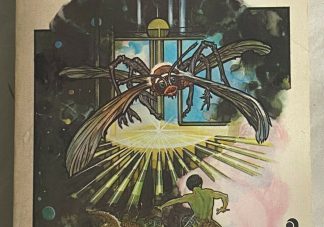
In Hanksville, Utah (population just over 100 depending on the time of year), I stumbled across a folk-art, sculpture garden masterpiece called Carl’s Critter Garden. You can find more online, but I got the real story straight from Dave, who’s been The Critter Garden Guardian for about eight years now. The place is equal parts surreal and twisted, rusted-out metal, not far from the canyons where Butch Cassidy and the Sundance Kid once hid out. My favorite piece? The resident giant space alien who greets you with an important announcement for “the People of Planet Earth”. The message is Everything Empathy—something that feels needed more now than it has in a long, long time.

Posted on Leave a comment

Five Things, Right Now.

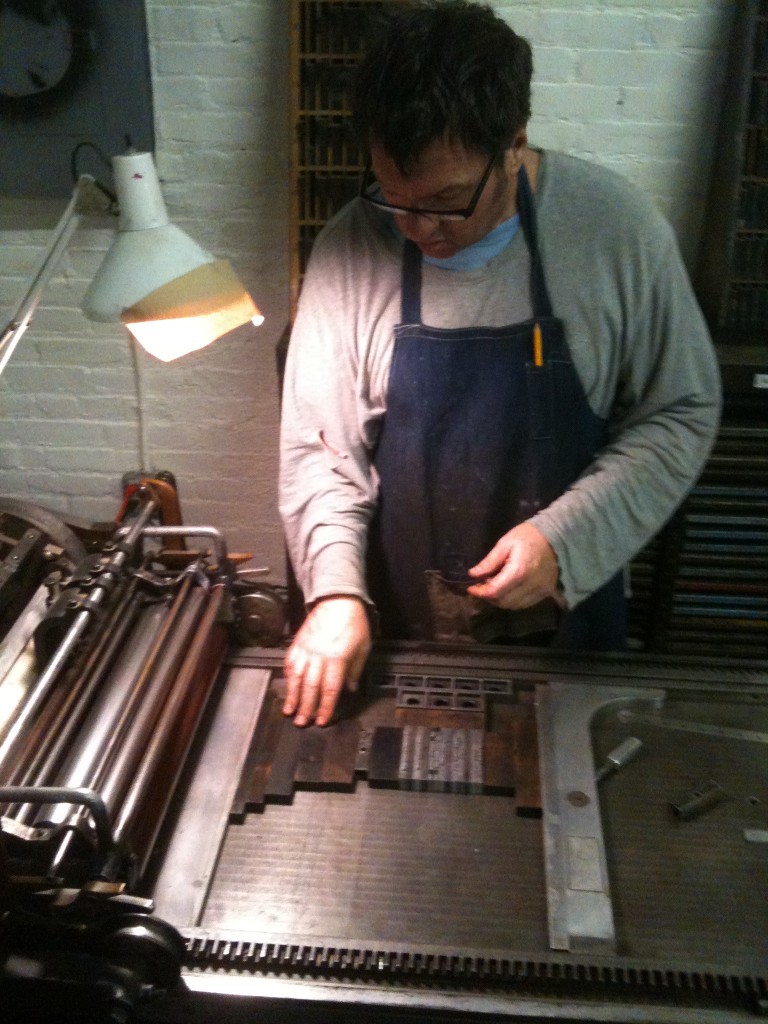
This is a picture of the Vandercook SP15

Hey hey oh hai everyone! I’ll kick off this batch of Five Things, Right Now with a line from T.S. Eliot: “If you’re not in over your head, how do you know how tall you are?” Which is just my fancy-pants, literary way of saying I have no idea when I’ll actually have five new, fun things to talk about. And probably not every Friday.

1. The Vandercook SP-15 Proof Press

Meet the new engine of the synaesthesia press! After years working on my Vandercook OS 219, I’ve made the move to the legendary SP-15 — a proof press compact enough to actually fit into my new garage-studio; but, like all “Vandys”, it’s built like a tank. Vandercook introduced the SP (“Simple Precision”) line in the 1960s, and the SP-15 quickly became one of the most popular presses they ever made. Printers love it because it strikes the perfect balance: a generous 14¾” × 20″ form area, precision engineering, and user-friendly controls. This press feels like the right size for where I am now — still capable of my artist’s books, broadsides, and oddball ephemera I love to make, but no longer overwhelming the space…and about 2000 pounds lighter than my OS 219. Give or take.  In short: it’s the perfect new anchor for the synaesthesia press. Expect to see new work rolling off this cylinder soon. I might even take a few jobs! Got a broadside idea you’d like me to print?

2. Tina Brooks – True Blue

Of course you know John Coletrane. You probably know Sonny Rollins. Maybe Cannonball? How about Tina Brooks? For me, he’s a haunting figure in jazz — a tenor saxophonist who had the sound, the ideas, the compositional talent, but never an audience. Which is one of the reasons I love him so. In 1960 he recorded True Blue for Blue Note, the only album released under his own name while he was alive. I’ve been streaming it for a couple years now. It’s a remarkable session: lyrical, inventive, full of personality, and yet it sank almost without a ripple at the time. Did I mention Brooks never found the audience he deserved? Or that I love The Creative Underdog?  Brooks’s life was cut painfully short. He struggled with heroin addiction, recorded sporadically, and by 1974, at age 42, he passed. Most of his music remained in the vaults until decades later, when (first) the Japanese collectors and (second) the reissue folks figured him out. True Blue is the work of an artist whose brilliance is evident, but who lived and died largely unseen.

3. Gorilla Biscuits at The Van Buren 6 Sept. ’25

They opened for The Circle Jerks. But I was there to see Gorilla Biscuits. Back in their first run (1991-ish?), I’ll be the first to admit I poo-poo’ed them. I poo-poo’ed the whole “straight edge” thing. It felt almost like an oxymoron to me, and I never gave any of those bands a chance. But I have no problem admitting when I’m wrong. Decades later? These guys shred. Their energy was off the charts, the songs tight and fast, and what’s better than people watching at a punk show? It’s a reminder that some music ages better than our own prejudices. And hasn’t punk aged well?! That’s probably one of the five things I should be writing about today.

4. It All Dies Anyway: L.A., Jabberjaw, and the End of an Era

On a recent trip to Half-Priced Books, I came across It All Dies Anyway: L.A., Jabberjaw, and the End of an Era. Essentially, it’s a love letter to a tiny, all-ages coffeehouse; but it’s known better as an underground music venue in L.A.’s “Mid-City” on Pico Boulevard. I wasn’t living in L.A. during its run, but I knew about Jabberjaw through Coop’s amazing, unforgettable show posters that made it into my local record store in Tempe, AZ, during the mid-90’s (and now go for a tidy sum). I love this book. And even though I never set foot inside Jabberjaw, this book makes me feel like I didn’t miss much… other than all the incredible bands that played there.

5. Jack Woody.

I’ve never met Jack Woody, but I feel like I know him in the same way I “know” Jabberjaw—through what was created. Woody founded Twelvetrees Press in the early ’80s as a nonprofit, so he could secure NEA money—back when that was still possible—and used it to publish the beginning of what would be daring, beautifully-made photo books. A few years later he launched Twin Palms as a for-profit house, and for a brief stretch between 1989 and 1992 the two overlapped. Everything Woody publishes amazes me: thick papers, deep inks, design so sharp it forces you to slow down as you turn each page. The list of photogs he’s published is staggering—from Mapplethorpe to Winogrand to Ginsberg to Herb Ritts to Eggleston and Disfarmer—and the books feel almost like Christmas Morning. Or Easter Brunch. Or a Diwali Festival. You get the idea.

I’ll end this with a humble flex: the Twin Palms summer sale just wrapped, and I managed to land a lettered copy of William Eggleston: For Now. There were a few signed copies still available(!) (which is what I ordered), but a lettered copy ended up in my library! I want to believe — somehow and some way — that Jack sent it to me himself. ‘Cause he feels my love for everything he makes…all the way from Arizona.

Posted on Leave a comment

Five Things, Right Now.

A picture of the R. Crumb zine "The Kinds of Girls I Like!"

1. A Major Flex (Sorry, Not Sorry!)
I’m going to kick off this week’s 5 Things Right Now with a flex. A major flex. Thing is, no one likes a braggart…but that’s what I’m about to do. Because a few weeks ago, I sent a handful of 4 Minute Mile to people I consider heroes, and one of them was R. Crumb. Yesterday, I opened my mailbox to find The Kinda Girl I Like!—marked “one of two copies.” Inside, a long handwritten letter where he riffs (in classic Crumb fashion) on the women in my zine, his own preferences, and even a memory about our mutual friend, the photographer Eric Kroll. Crumb really has been a hero to me, and to receive anything directly from him—sparked by something I made—is about as surreal as it gets. Seriously, I ain’t braggin’; it’s about sharing a rare moment where the creative energy you throw into the world actually bounces back in the most unexpected, humbling…and inspiring way. Which I really needed, cause I’ve sold like 6 copies of Four Minute Mile, almost all to friends.

2. Stanley Turrentine & The Three Sounds’ Blue Hour.
This week, I’ve had Blue Hour on replay. Re-stream? Whether I’m reading, working, or about to fall asleep. If someone could create the perfect soundtrack to the Beat Generation, this is it. Ever hear something and wonder, why did it take me so long to discover this?! Turrentine and his three sounds — pianist Gene Harris, bassist Andrew Simpkins, and drummer Bill Dowdy — in a beautifully subdued session. If you’re a Blue Note nerd like me, it’s BLP 4057. It’s been reissued in their Classic Vinyl Series, remastered from the original tapes and pressed into that thick, glorious 180g vinyl—it’s sonic heaven for late-night spinning, Daddy-O. Or late night streaming. It’s so good, I’m ordering the record. Cause I’m buying records again. Albums. LP’s. EP’s. 45’s. Just whatever you do, please don’t call them “vinyls”.

3. Alien Earth (Hulu)
I’ve really been digging into Alien Earth. It’s basically the Alien franchise stirred up with some brand-new, gross, squirm-inducing-and-awesome little critters (the Octopus Eyeball is my current favorite—equal parts ridiculous and terrifying). The story is Philip K. Dick crash-landing into an H.R. Giger nightmare. Which isn’t that far off, cause there’s a terrific crash landing that kicked this season off. And there’s Sydney Chandler, too. She’s just terrific, carrying so much of the show’s strange humanity while dodging (and sometimes embracing) its nightmare. How about a little more Sydney from here on out? I don’t care if she’s a nepo baby; truth is, without Marcy / Wendy, I’m not sure I’d still be watching.

4. Wet Leg at the Tiny Desk
Everyone should know NPR’s Tiny Desk series by now — it’s practically a rite of passage for any band with buzz. What you might have missed is Wet Leg’s recent performance promoting their new record, Moisturizer. I’ve loved Wet Leg since first hearing the greatest song ever written about a chaise longue: they’ve got guitars, hooks, and a perfect mix of cheeky and dead-serious. But I’ve always been a sucker for fem-powered pop melodies built on loud guitars. Watching them cram their energy into a cozy NPR office just makes it better — that spirit in long hair and beards and a Holden-Caulfied hat, shoulder pads built for hockey players, a red phone and library chairs.

5. Steve Diet Goedde’s Little Edition Print Subscriptions
Every month a small brown envelope lands in my PO Box with a little magic inside. This month it’s Print SDG062—a superb image of burlesque model Lucy Fur. Goedde’s thing is elegant, low-key fetish in luminous black-and-white; he shoots only with available light, and the tonality is why these tiny prints feel so big. If you don’t know the subscription, it’s the best 10 bucks you’ll spend—all mailed in his brown craft envelopes I’ve come to look forward to. It’s intimate, affordable, and old-school in the very best way.  If you don’t know Mr. Diet Goedde: a long-time LA fine-art erotic photographer (Beauty of Fetish, Extempore), with a style that reads as much fashion as fetish—precise, composed, and human. If you’re curious, his shop and books are an easy rabbit hole.

Camera note for the nerds: he regularly mentions the Mamiya 645 and T-Max 400 in posts/interviews — the recipe for his (now) not-so-secret sauce.

Posted on Leave a comment

Five Things, Right Now.

A recent picture of Matt Sharpe from The Rentals

1. The Rentals — “Shake Your Diamonds” + “Forgotten Astronaut”

I’ve been streaming “Shake Your Diamonds” and “Forgotten Astronaut” off Q36, The Rentals’ last record, way too much lately. What started as a 48-hour obsession with Weezer’s first two albums a few weeks ago landed me here, mostly because of Matt Sharp’s charisma back when he was their bassist. But does anyone care about The Rentals since “Friends of P.”? I have no idea. These two tracks are strange, spacey, and glammy — the kind of songs that sound like they’re straight outta ’74. Which is exactly why I love them. But hey, I’m no music critic. Here’s a serious question: should “Shake Your Diamonds” and “Forgotten Astronaut” count as two things on this list?

2. Peggy Guggenheim — Out of This Century: Confessions of an Art Addict

I’ve been flipping through Peggy Guggenheim’s memoir again, and wow — nobody name-drops like Peggy. And I mean flipping, because this book is half gossip column, half crash course in modern art history. One page she’s lamenting her lovers, the next she’s buying a Pollock or shrugging at Duchamp or telling me all about Djuna Barnes’s lesbian loves. (Duchamp! Did you know everyone in 1923 Paris wanted to bang him?!?) This is the kind of stuff I love. Even skimming it feels unfiltered, messy, vain, brilliant — and pretty funny, too. Which is to say it’s worth a skim and not much more.

3. The Golden Age of Hollywood and Florence Lawrence!

I’ve fallen down the early-Hollywood rabbit hole more than once. It started with a pile of old de-commissioned stills I dug out of a junk shop across the way from MacArthur Park near DTLA. Lately it’s continued with Netflix’s Titans: The Rise of Hollywood. As documentaries go, it’s a little cheesy… but watchable. And Florence Lawrence! Who knew? She was the first movie star — and yeah, her name also sounds like it could’ve been her porn star alias, too. Just sayin’.

4. The Black Sparrow Press, Post–John Martin

I’ve been thinking a lot about Black Sparrow Press since John Martin passed, and honestly — Joshua Bodwell has done a terrific job carrying the torch. I’m in the middle of the Dan Fante’s terrific short story collection Short Dog: Cab Driver Stories from the L.A. Streets, and the New Year’s greetings — Wanda Coleman (2020) and Richard Bucker (2021) — fit perfectly in step with tradition. They’re beautifully produced, respectful of the past but not afraid to move forward. For a press so tied to the Bukowski / Fante lore, it’s impressive to see BSP still evolving. Bodwell is finding new voices while honoring the ones that made BSP matter in the first place. Bravo sir!

5. Austin Kleon  Steals Like an Artist.

Austin Kleon is a true champion for creatives — whether you’ve got a massive audience or you’re just scribbling in your secret notebook. His books (Steal Like an Artist, Show Your Work, Keep Going) are part pep talk, part how-to, and somehow just as useful the tenth time through as the first. All three have a place in my studio. Every week he posts “10 things worth sharing this week” on his site: art, music, literature, rabbit holes; hence, Five Things, Right Now. Cause I’m a thief. And as Austin reminds us (and Picasso before him), great artists steal. You can pretty much count on Kleon dropping his list every Friday. But me? What’ll be here next Friday?

Your guess is as good as mine.

Posted on Leave a comment

5 Summer Highlights: Rare Books & Photos for the Collector

A picture of Bukowski's second book published by Epos inscribed with drawing of two dogs.

Summer always brings its own rhythm — slower days (no wonder I haven’t blogged in a while — well, that and Covid), shorter nights, and, if you’re lucky, the kind of finds that make the summer of ’25 worth remembering. It might be a little dorky to call this a “heatwave of collecting”… but hey, I’m a dork. So here are five things I’d buy if I were you: rare books, unexpected paperbacks, and a photograph that hit me like a favorite song — a mix of poetry, raw street photography, jazz memoir, and pin-up iconography. Together, they make a strange but fitting portrait of what interests me most lately.

Charles Bukowski — Epos: A Quarterly of Poetry (1962)

I’m gonna call being a Bukowski completist a near-impossible mountain to climb. Owning all the BSP titles an expensive task. But what about making a run for the first 10 chapbooks? Still kinda expensive…but doable I say! Bukowski’s second book, tucked inside a “little” called Epos that came straight outta Crescent City, Florida. Five (or so) years before the beautiful Black Sparrow titles and at the start of what I’ll call “The Cult of Buk,” Charles Bukowski was hustling poems and growing his audience with small journals like this one. As the title says, this special issue featured his poems and drawings. Is this the point he starts pushing past the underground mimeo world?

This copy inscribed in big, bold Buk handwriting from 1969: “Early poems, early screams.” That’s the kind of thing only he could scrawl without irony. He even threw in a quick drawing inside the cover / endpaper, as if to remind you that poetry was just one of the ways he made marks on paper. For a Bukowski collector, I’ll go as far as to say this is a real score — not just because it’s scarce, but with its signature and bold drawing, it carries the whole arc of the title.

Mike Disfarmer — Photographs

Disfarmer was one of those small-town photog kooks who only makes sense in hindsight. He set up his studio on Main Street in Heber Springs, Arkansas, and spent decades shooting portraits of farmers, families, and the local kids with his no-frills, plain-backdrop style. No props, no glamour, no “rules” — just faces staring straight into the camera, caught somewhere between dignity and awkwardness. At the time, nobody thought twice about them. Now? They feel like haunted little snapshots of America’s heartland, unpolished and unforgettable. And if you’re thinking maybe I should jump in a car, road-trip it to Heber Springs, and knock on random doors with a pocketful of cash to see which families are sellers — you’re too late.

The Photographs book from Twin Palms is where a lot of collectors (myself included) first really learned — they fell — for him. BTW I love Twin Palms / Twelvetrees. As with all their titles, the production is second to none: heavy stock, deep black-and-whites, binding that feels like it was built to outlast us. Every page has weight, every portrait space to breathe. For photobook collectors, this one’s deceptively simple but ends up being indispensable — the kind of book you pull down when you want to remember that America was never as simple as you might imagine. Did I mention this title is long out-of-print?

Garry Winogrand — Winogrand Color (Limited Edition, Twin Palms)

Most know Winogrand for his black-and-whites — New York streets, airports, political rallies — where every picture feels like everything in his frame is seconds away from falling apart. Or coming together. But Winogrand Color is something else entirely. Working in Kodachrome (because who doesn’t love Kodachrome!?), he caught the same restless energy — but through a completely different lens. It’s America in full saturation, and like all color work, it hits differently. If his black-and-white images feel like history, his color pictures feel almost like life still in progress.

And then there’s the book itself — another amazing Twin Palms / Twelvetrees production. Here I go again. They didn’t just throw the slides into a binding; they made something special. Heavy pages, big reproductions, and the kind of design that makes you linger. The copy I’m flexing here is one of the slipcased limiteds, and it comes with a tipped-in photograph of Women Walking right on the slipcase. That little detail makes it feel even more alive, as if The Man himself just dropped a print in your hands. For collectors, this isn’t just a photo book — it’s a Big Book, and proof that even in color, Winogrand could bend the world to his eye.

Mezz Mezzrow & Bernard Wolfe — Really the Blues (Dell Paperback)

Mezz Mezzrow wasn’t just a clarinet player — he was a hustler, a self-mythologizer, and a bridge between the jazz underground and the mainstream. In other words, my kinda dude. This memoir, co-written with Bernard Wolfe, reads like one long riff: Harlem rent parties, Louis Armstrong, reefer smoke thick enough to choke, and a life lived half in shadows, half in neon. It’s one of the first real “insider” accounts of jazz culture, written in a hipster slang so authentic it practically swings off the page. Oh yeah Daddy-O!

And then there’s the copy I’m offering — the Dell paperback, complete with its lurid, oversized type screaming “TRUE… SHOCKING.” This is where literature meets pulp, and the combination is irresistible. Collecting paperbacks is on the rise — maybe it’s the price point, maybe it’s the “everything vintage” thang…maybe it’s just the sheer thrill of holding a book that feels like it’s lived a dozen lives before it landed in your hands. For me, it’s about the object itself: cheap paper, wild cover design, the promise of something lurid and forbidden between the covers. Really the Blues is all that and more — a cult jazz memoir hiding inside the skin of dime-store paperback sleaze.

Bettie Page — “Devil Girl” by Bunny Yeager

If Bukowski was the poet of America’s underbelly and Mezzrow was its jazz hustler, then Bettie Page was its grinning, winking id. Nobody has ever mixed innocence and danger quite like her. In this original, silver gelatin Bunny Yeager picture “Devil Girl” shot, Bettie looks like she just stepped out of a pulp comic — horns on her head, tail curling behind her, smile wide enough to let you know she’s in on the joke. It’s camp, it’s kitsch, it’s sex appeal with a wink.

This particular print is one of those pieces that stops you in your tracks, partly because it’s Bettie (always a showstopper), and partly because it’s Yeager at her most imaginative. Developed in the 80’s, stamped on verso, and signed by Bunny Yeager. The composition? Pure mid-century fantasy — playful menace wrapped up in satin and a smile with horns. For pin-up and picture collectors, Bettie is ground zero, and for Bettie collectors, Yeager is the high priestess behind the lens. The “Devil Girl” image hits both marks at once. Call it kitsch, call it art, call it Americana, or an investment — but whatever you call it, this one’s the devil you’ll gladly make a deal with.

Posted on Leave a comment

Four Minute Mile: A Limited-Edition Photozine by Jim Camp

A picture of the photozine Four Minute Mile by Jim Camp and published in 2024 by the synaesthesia press.

There’s a reason most self-published work is self-published. Sometimes it’s a vanity project. Sometimes it just isn’t “very good”. I get that. But I’ve been making pictures for a while now, and enough people have taken notice that I figured it was time to put more of my work out there—on my own terms.

Four Minute Mile is my first self-published photozine. It collects some of my portraits—though I’m not a big fan of the traditional definition of portraiture. Some of my favorite subjects are strangers, other photographers at work, sex workers, oddballs, and weirdos. People who made me pause, or made me nervous. People who truly earn their living. Some I know well. Some I met literally seconds before I hit the shutter. All of them terrific subjects.

I’m a big believer in Cartier-Bresson’s idea of a “decisive moment.” I also think about Eggleston’s “democratic way of looking around.” I probably think about stuff like this way more than I should. And in our digital world where everyone’s a photographer, the real challenge is getting someone to stop and do a little more than just glance at your picture.

Four Minute Mile is full color, short run—99 numbered copies and 26 lettered copies that come with a giclée print laid in. I made the pictures in all kinds of places: on the street, in flea markets, thrift stores, porno sets, red carpet events, backyard BBQs, hotel lobbies, and professional studios.

There won’t be any reprints. But Four Minute Mile will be a quarterly series—until it runs its course. I’ve got a lot of images I’d like to show you, so who knows how long that’ll take.

In the meantime, here we go.

Posted on 4 Comments

In Memoriam: John Martin

A picture of John Martin

I can say without hesitation that John Martin was the single biggest influence in my life.

Not because he published Bukowski—though that was the start—but because of what he built: The Black Sparrow Press. A press with vision, with guts…and a whole lotta style. The first BSP book I ever held was Burning in Water, Drowning in Flame, and I bought it minutes after walking out of the movie theater where I’d just seen Barfly.

I didn’t know who Charles Bukowski was. I just knew I liked the movie. And then there it was: a book in bright orange wraps with a title that looked like it had been pulled out of who-knows-where. I didn’t know yet that this book actually collected three of Bukowski’s earlier volumes. I didn’t know it would become, in my opinion, the best single-volume entry point into his poetry. All I knew was: I needed that book.

And then I devoured it.

I didn’t know yet that I was stepping into a whole universe—one built not just by Bukowski, but by a publisher with vision who had a designer with an eye for the extraordinary. And when I got to the end—to the colophon page—something happened. I had never even heard the word colophon. But there it was. Martin’s voice. His care. His note about the design, the typography, the printer, the limitations. It was the first time I realized a book is a made thing—not just a container for content, but a piece of art, crafted start to finish.

Of course, none of those Black Sparrow books would’ve looked or felt the way they did without Barbara Martin, John’s wife and the designer behind the press’s entire visual identity—those were hers. Her aesthetic became Black Sparrow’s signature, and it left a mark on every one of us who ever judged a book by its cover. Who can’t spot a BSP title from a mile away?

And while it would’ve been easy—maybe even profitable—to stick with “sure things” like Bukowski or Fante, John Martin did something braver. He took real financial risks on writers who had little-to-no audience at all: John Yau, Larry Eigner, Fielding Dawson, Ron Loewinsohn, Paul Goodman—names few remember, but whose voices were preserved because Martin believed in them. That’s where his heroism lies. That’s what made Black Sparrow more than just another “indie” press.

Bukowski got me to the Beats, to the little mags and Marvin Malone and Gypsy Loy & Jon Webb. Hal Norse. Jack Micheline. Johnny Brewton and his work, too! The Beats got me to “academic” literature, for lack of a better term. And John Martin’s colophons—those little back-page meditations—led me, ultimately, to the founding of the synaesthesia press.

How about that?

All because I walked into a movie theater to see a Mickey Rourke flick. All because I grabbed a book in bright-orange wraps.

Rest in peace, John. And stay strong, Barbara. You made books that mean something. You built a life on championing voices most publishers wouldn’t touch. You made literature cool. And for at least one young man walking out of a movie theater and into the buzz of a mid-1980’s, new-and-used bookstore (when bookstores really buzzed), you changed everything.

Thank you.

Posted on Leave a comment

Starting Over with Blue Note 1500s (Because 10 Records Wasn’t Enough)

A Picture of Blue Note 1558 Sonny Rollins Volume 2.

I’m the first to admit a bad idea. Especially when I’ve made it.

Bikram Yoga, just off the top of my head. It’s tough enough sitting in a 105-degree room for 90 minutes. Add the same 26 postures, over and over, and you’re slow-roasting in a humidified cult. And yeah, the people who really love it? Like I said — culty. And kooky. Making for an unsustainable practice.

Picking up a skateboard after a couple decades, thinking I’d pick up right where I left off? Bad idea. I’m lucky I didn’t break an arm — or at least dislocate a shoulder. And how come adults don’t fall like kids do?

Pulling out the novel I submitted for my MA at the University of San Francisco? Still in the box I taped up in 1999. I’ve got a feeling that’s going to be a bad idea, too.

Then there was the day I sold off my entire record collection. Honestly? Not a bad idea. But when I shook The Record Dealer’s hand, I got a little verklempt. Not over the sale itself — more the sense that a chapter was ending. I blogged about it. Almost went a little cry baby.

The Record Dealer just smiled and said, “Don’t be upset. Just start collecting again!”

So I did…sort of.

And I made up a rule: only ten records, max. If I wanted to bring home an eleventh, I had to choose one to cut and trade back in. A brilliant idea, right?

Meh.

For reasons I can’t fully explain, it really didn’t stick. Elegant in theory; not so much in practice. Come to think of it, not-so-elegant in theory, either.

Which brings me to what will almost certainly be another bad idea: the Blue Note 1500 series.

From 1955 to 1957 (give or take), Blue Note released 99 albums, starting — of course — with 1501: Miles Davis Volume 1. The 1500s might be the most iconic run in jazz history. Legendary musicians. Unmistakable sound. And the cover art? Mid-century amazing. Clean layouts, bold typography, and some incredible Francis Wolff photos. A whole aesthetic summed up in less than 100 records.

Collectors have been chasing them for decades. Some pressings go for absurd money. Like, “you could’ve gone on a really nice vacation” money.

And yet, I’ve been thinking about this much longer than I’d like to admit. Perhaps waiting for a sign. A sign from wherever the signs come from that trigger The Collector to start collecting. Then, a few days ago, I walked into Grace Records. I’ve mentioned Grace before. Just like I’ve been blogging about this whole 10-record thing. I walked into Grace, and there, in one of the three boxes behind the cashier, that sign appeared. A wonderful, beautiful sign, solid black, highlighting The Man with the tenor saxophone in blue with amazing white & blue typography. And a first pressing!! For less than a hundred bucks! In decent shape!

So yeah. I’ve made another bad decision.

Besides, I’ve been lucky enough to visit Europe a whole lot. And Hawaii? It’s totally overrated.